
Another voice from the end of captivity.
Intro info
In the chronological reading of the Old Testament, Ezra was interrupted to hear from Haggai.
Haggai means "my feast". (probably born on a feast day)
Likely, Haggai came back to Jerusalem with Zerubbabel and when the rebuilding of the Temple stalled, as we read in Ezra, God chose a voice to call the people back to the work. Although, he is not mentioned by name in Ezra's census.
Haggai was a contemporary of Zechariah. He is mentioned in the book of Ezra twice. In the east, Confucius lived in this same era.
His tribe and occupation are unknown. Because he references seeing Solomon's Temple, he has to be at least 70 years old.
The date was 520 BC.
This is the second shortest book in the Old Testament and it's only quoted in the New Testament once.
The MacArthur Commentary cleared up the confusion about Darius. The Darius from Daniel was Darius the Mede, King of the Medes in the Medo-Persian alliance. Then Cyrus rose to prominence as the King of Persia. This Darius is the grandson of Cyrus' brother, so the army stayed loyal to the family.
MacArthur also includes an interesting diagram about Zerubbabel:
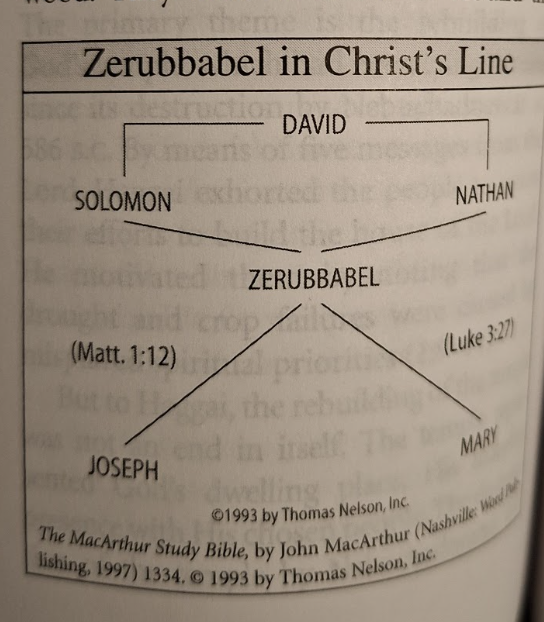
I've mentioned before that I was unclear how the Davidic line could continue after the fall of Judah; but this is how. This one man with the funny-sounding name is the linchpin. It never ceases to amaze me how God moves His story along, with perfect precision that can only be seen looking back.
Haggai 1
In the second year of Darius (Hystaspes), Haggai has a word from the Lord fro Zerubbabel (the son of the governor of Judah) and the high priest, Jeshua (Joshua). Jeshua was the son of the man who was high priest when the Babylonians invaded.
In verse 2, God repeats what's being said by the remnant now living back in Jerusalem (after being set free from the Babylonian captivity). They decide that it's just not time for the Temple to be rebuilt.
To which God answered, apparently the time is right for you all to live in your paneled houses while My House is in ruins. God commands them to consider their ways. This is a stunning indictment. Panel houses means they were fashioning wood to make themselves nice homes. That wood was imported, probably for the work that was to be done on the Temple. So they were just fine doing construction owrk but only for themselves and not the Temple they had been sent to rebuild. That's shocking.
On the other hand, I always discover the same sins as Israel when I look at my own life. How many resources meant for God's work have I use to make myself comfortable. Sadly, I suspect God can put an exact number to that and it makes me ashamed. I'm assuming the remnant felt the same when they heard Haggai's prophesy.
You have sown much, but harvest little; you eat, but there is not enough to be satisfied; you drink, but there is not enough to become drunk; you put on clothing, but no one is warm enough; and he who earns, earns wages to put into a purse with holes.” Haggai 1:6
This is what happens when you're going away from God. Everything gets harder and the results gets smaller. It's God's impossible math in reverse. It's a sickening and frustrating place to be.
Verse 7 repeats God telling them to consider their ways. Then He speaks clearly, not metaphor or imagery. Just a command:
Go up to the mountains, bring wood and rebuild the temple, that I may be pleased with it and be glorified,” says the Lord. Haggai 1:8
That's what we want. That's when God's impossible math works for us, when we care about God's glory and we seek to please Him instead of ourselves or others. Get to it, kids.
In verse 9, He repeats the indictment:
“You look for much, but behold, it comes to little; when you bring it home, I blow it away. Why?” declares the Lord of hosts, “Because of My house which lies desolate, while each of you runs to his own house. Haggai 1:9
While this sounds harsh and angry, it's important to note that God is communicating directly and clearly with them God is knowable and relational. That amazing and such good news. It's also a blessing to know that God will disrupt our lives when we're off-target. He will get us back on track with our purpose, if we obey.
He specifies that the drought and poor harvest have been His way of getting their attention. He even specifies that the labor of their hands has suffered. Our prosperity and provision, even the work of our own hands comes from the Lord. If your purse has holes in it and your coins keep getting lost, check your purpose and you worship.
I find this incredibly convicting. God doesn't change. We're still to be about His work.
Starting in verse 12 the people respond.
Then Zerubbabel the son of Shealtiel, and Joshua the son of Jehozadak, the high priest, with all the remnant of the people, obeyed the voice of the Lord their God and the words of Haggai the prophet, as the Lord their God had sent him. And the people showed reverence for the Lord. Haggai 1:12
These were special people, chosen for a special season and purpose. They got lulled to sleep by the obstacles they faced; but woke right up when called.
And what does God do when His people respond faithfully to His correction:
Then Haggai, the messenger of the Lord, spoke by the commission of the Lord to the people saying, “‘I am with you,’ declares the Lord.” Haggai 1:13
I am with you.
And that's it. That's all they needed. All we need. God with us.
Even though I walk through the valley of the shadow of death,
I fear no evil, for You are with me;
Your rod and Your staff, they comfort me. Psalm 23:4
Here's what happens when we respond to the Lord with obedience, even after we stumble:
So the Lord stirred up the spirit of Zerubbabel the son of Shealtiel, governor of Judah, and the spirit of Joshua the son of Jehozadak, the high priest, and the spirit of all the remnant of the people; and they came and worked on the house of the Lord of hosts, their God, Haggai 1:14
He stirs up our spirit. The work of our hands becomes turbo-powered by the Lord and the result are blessed, not hindered.
Verse 15 ends the chapter by telling us that this first prophesy and response happened on the 24th day of the sixth month in King Darius' second year. This kind of precision dating is helpful for the skeptics and historians.
We serve a loving God who is our coach, our teacher, and our Father.
Amen.